
What Kind of Telehandler Do I Need?
Choosing the right telehandler can make a significant difference to productivity, operating costs and safety on site. With different lifting capacities, reach heights, dimensions and attachment options available, it is important to select a machine that matches the work you actually need to carry out.
Whether you are working in construction, agriculture, groundworks, waste management, landscaping or general material handling, there is a telehandler designed for the job. But how do you know which one is right for your business?
In this guide, we look at the key factors to consider when choosing a telehandler and explore the SANY telehandler range available from Banner Equipment.
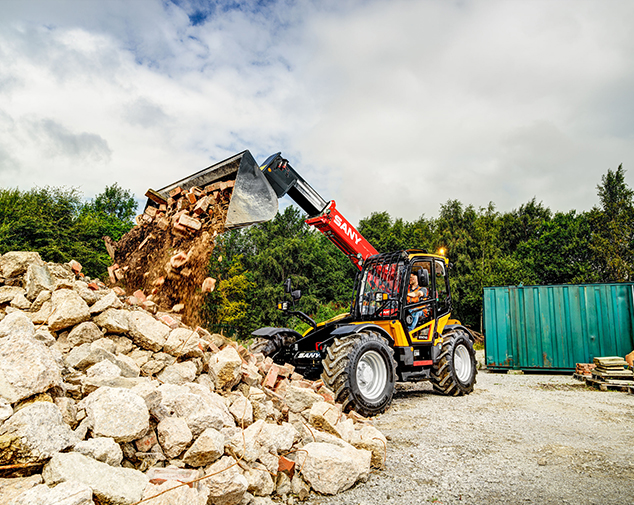
What Will You Use Your Telehandler For?
The first question to ask is simple: what jobs will the telehandler be doing?
A machine used primarily for moving pallets around a construction site may have very different requirements from one used for loading aggregate, handling waste or moving materials around a farm.
Common telehandler applications include:
- Moving pallets of bricks, blocks and building materials
- Loading and unloading delivery vehicles
- Moving aggregates and loose materials
- Handling timber and landscaping materials
- Loading waste and recycling materials
- Moving materials around farms and agricultural sites
- Feeding materials into processing equipment
- General construction site material handling
- Lifting materials to upper floors or elevated working areas
Making a list of your typical jobs before choosing a machine can help you identify the lifting capacity, reach and attachment requirements you actually need.
How Much Weight Do You Need to Lift?
One of the most important considerations is lifting capacity.
Telehandlers are available with different maximum lifting capacities, but it is important not to look at the maximum figure in isolation. A machine’s actual lifting capacity can vary depending on factors such as boom position, load centre and reach.
For example, a telehandler might be capable of lifting a particular weight when the boom is retracted, but its capacity can be significantly different when the boom is fully extended.
Think about the heaviest loads you regularly need to handle rather than choosing a machine purely because it has the highest possible lifting capacity.
You should also consider the size and shape of the loads. Pallets, bulk bags, attachments and irregularly shaped materials can all behave differently when lifted.
Choosing a telehandler with an appropriate capacity gives you a useful operating margin without necessarily paying for a machine that is larger than your business requires.
How High Do You Need to Reach?
The next major consideration is maximum lift height.
If you are using a telehandler to place materials onto scaffolding, upper floors or high storage areas, you will need enough lift height to complete the task safely.
On the other hand, if most of your work involves moving materials at ground level, an extremely high-reach machine may not be necessary.
Think about the highest point you need to place materials and allow for sufficient working clearance.
It is also worth considering how often you will actually use the maximum reach. A machine with an impressive maximum lift height may not be the most suitable choice if most of your work involves shorter lifts and material handling.

How Far Do You Need to Reach?
Maximum reach is another important specification.
The telescopic boom allows a telehandler to position loads forward from the machine, which can be particularly useful when placing materials in restricted areas.
For example, on a construction site, you may need to reach over an obstacle or place materials further into a building.
However, just like lifting capacity, the load capacity of a telehandler changes as the boom extends. This is why it is essential to consider the machine’s load chart rather than simply looking at maximum lift capacity.
Your telehandler supplier should be able to help you understand the machine’s load chart and determine whether it can safely perform your intended applications.
Compact or Larger Telehandler?
The physical size of the telehandler matters too.
A compact telehandler can be particularly useful on smaller construction sites, building projects and confined areas where space is limited.
Smaller machines can offer advantages when manoeuvrability is more important than maximum capacity or reach.
Larger telehandlers, meanwhile, can be better suited to demanding applications where higher capacities, greater reach and increased productivity are required.
Consider:
- Site access
- Working space
- Door and entrance dimensions
- Ground conditions
- Transport requirements
- Turning space
- Maximum lifting requirements
- Required reach
There is little benefit in choosing a machine that is unnecessarily large if it makes access and manoeuvrability more difficult.
SANY Telehandlers
SANY has developed a growing range of construction equipment, including telehandlers designed to provide versatility, performance and operator-focused features.
At Banner Equipment, SANY telehandlers provide businesses with options for a range of material-handling applications.
One of the models available is the SANY STH625 telehandler, which is designed as a compact and versatile machine for applications where manoeuvrability, lifting performance and flexibility are important.
The STH625 can be suited to a range of construction and material-handling tasks, making it an option worth considering for contractors looking for a versatile telehandler.
SANY STH625 – A Versatile Choice
The SANY STH625 is a compact telehandler designed to provide useful lifting and reach capabilities while remaining suitable for working in environments where space can be restricted.
For contractors, groundworkers and construction businesses, a machine such as the STH625 can provide a practical solution for moving materials around site.
Its versatility also means that the machine can be used with different attachments, helping businesses get more from a single machine.
Depending on the attachment being used, a telehandler can move palletised materials, handle loose materials or carry out other specialist tasks.
For businesses that need one machine to perform multiple jobs, this flexibility can be particularly valuable.
Think About Attachments
One of the biggest advantages of a telehandler is the ability to use different attachments.
Forks are perhaps the most familiar attachment and are ideal for handling palletised materials. However, they are only one option.
Depending on the machine and application, attachments can include:
- Pallet forks
- Buckets
- Bale handlers
- Material handling attachments
- Work platforms
- Specialist lifting attachments
Before purchasing a telehandler, consider what attachments you are likely to use.
It is also important to make sure the attachment is suitable for the machine and application and that it is used in accordance with the manufacturer’s requirements.
A telehandler with the right attachment can be significantly more versatile than a machine limited to a single task.
Where Will You Be Working?
Your working environment can influence which telehandler is most appropriate.
Construction sites can present uneven ground, restricted access and constantly changing working conditions. Agricultural applications may involve muddy fields, yards and storage areas, while waste and recycling operations can involve demanding material-handling environments.
Consider the surfaces on which the machine will operate and whether you require features such as four-wheel drive or different steering modes.
Site conditions can also affect tyre selection and overall machine configuration.
If you regularly move between different locations, transportability is another consideration. The size and weight of the telehandler may affect how it is transported between sites.
What About Operator Comfort?
A telehandler may spend many hours working on a busy site, so operator comfort should not be overlooked.
Good visibility, intuitive controls and a comfortable cab can all contribute to an efficient working environment.
When comparing telehandlers, consider:
- Cab visibility
- Seating position
- Control layout
- Access and egress
- Climate control
- Noise levels
- Visibility around the machine
- Ease of operation
An operator who spends long periods in a machine needs a working environment that allows them to carry out their tasks efficiently and comfortably.
New or Used Telehandler?
Another decision is whether to purchase a new or used machine.
Used telehandlers can offer a lower initial purchase price, but it is important to consider the machine’s age, operating hours, service history and condition.
Buying new can provide the reassurance of a new machine and manufacturer-backed support, while also allowing you to select the specification and attachments that best match your requirements.
At Banner Equipment, our team can help you understand the available SANY telehandler options and identify a machine suitable for your application.
Don’t Choose on Maximum Capacity Alone
It can be tempting to choose a telehandler based on the biggest lifting capacity or greatest reach available.
However, the largest machine isn’t automatically the right machine.
A telehandler should be selected based on the work it needs to perform. Buying a machine that is significantly larger than necessary can affect purchase costs, fuel consumption, transport requirements and manoeuvrability.
Equally, choosing a machine that is too small can limit productivity and prevent you from safely completing certain tasks.
The aim is to find the right balance between capacity, reach, size, versatility and operating costs.
So, What Kind of Telehandler Do I Need?
The answer depends on your individual requirements.
Before choosing a telehandler, consider these key questions:
What is the heaviest load you need to lift?
This will help determine the required lifting capacity.
How high do you need to place materials?
This determines the lift height you need.
How far forward do you need to reach?
Consider the required forward reach and how load capacity changes as the boom extends.
Where will you be working?
Think about site access, ground conditions, working space and transport.
What attachments do you need?
Make sure your chosen machine can accommodate the attachments required for your work.
How frequently will the telehandler be used?
If it is going to be a key machine in your fleet, operator comfort, productivity, reliability and support become particularly important considerations.
Find Your SANY Telehandler at Banner Equipment
Choosing the right telehandler is about matching the machine to the job rather than simply choosing the biggest or most powerful option.
SANY telehandlers offer a versatile solution for businesses looking for a machine capable of handling a wide variety of construction and material-handling tasks.
The SANY STH625 is one option for businesses looking for a compact and versatile telehandler, while Banner Equipment can help you understand the available specifications and determine which machine best matches your requirements.
As a supplier of SANY construction equipment, Banner Equipment can provide advice on machine selection, attachments and applications.
If you’re considering investing in a new telehandler, get in touch with Banner Equipment today to discuss your requirements and find out more about the SANY telehandler range.
Banner Equipment – SANY telehandlers for versatile, efficient material handling.