The Different Types of Tesab Jaw Crushers and What They're Best Used For
When it comes to processing hard rock, aggregates, demolition materials and other demanding feedstocks, choosing the right jaw crusher is essential. The right machine can help improve production, reduce unnecessary wear, create a consistent feed for downstream equipment and keep material processing moving efficiently.
Tesab jaw crushers are designed primarily for primary crushing applications, taking large pieces of material and reducing them to a size suitable for further processing. With tracked mobility, robust construction and a range of machine sizes available, Tesab offers jaw crushers for different production requirements and applications.
At Banner Equipment, customers can access Tesab crushing equipment for quarrying, recycling, construction and aggregate applications.
But with several models available, which Tesab jaw crusher is right for your operation?
In this guide, we’ll look at the different Tesab jaw crushers, what makes each model different and the types of applications they are best suited to.

What Is a Jaw Crusher?
Before looking at individual Tesab models, it is useful to understand what a jaw crusher does.
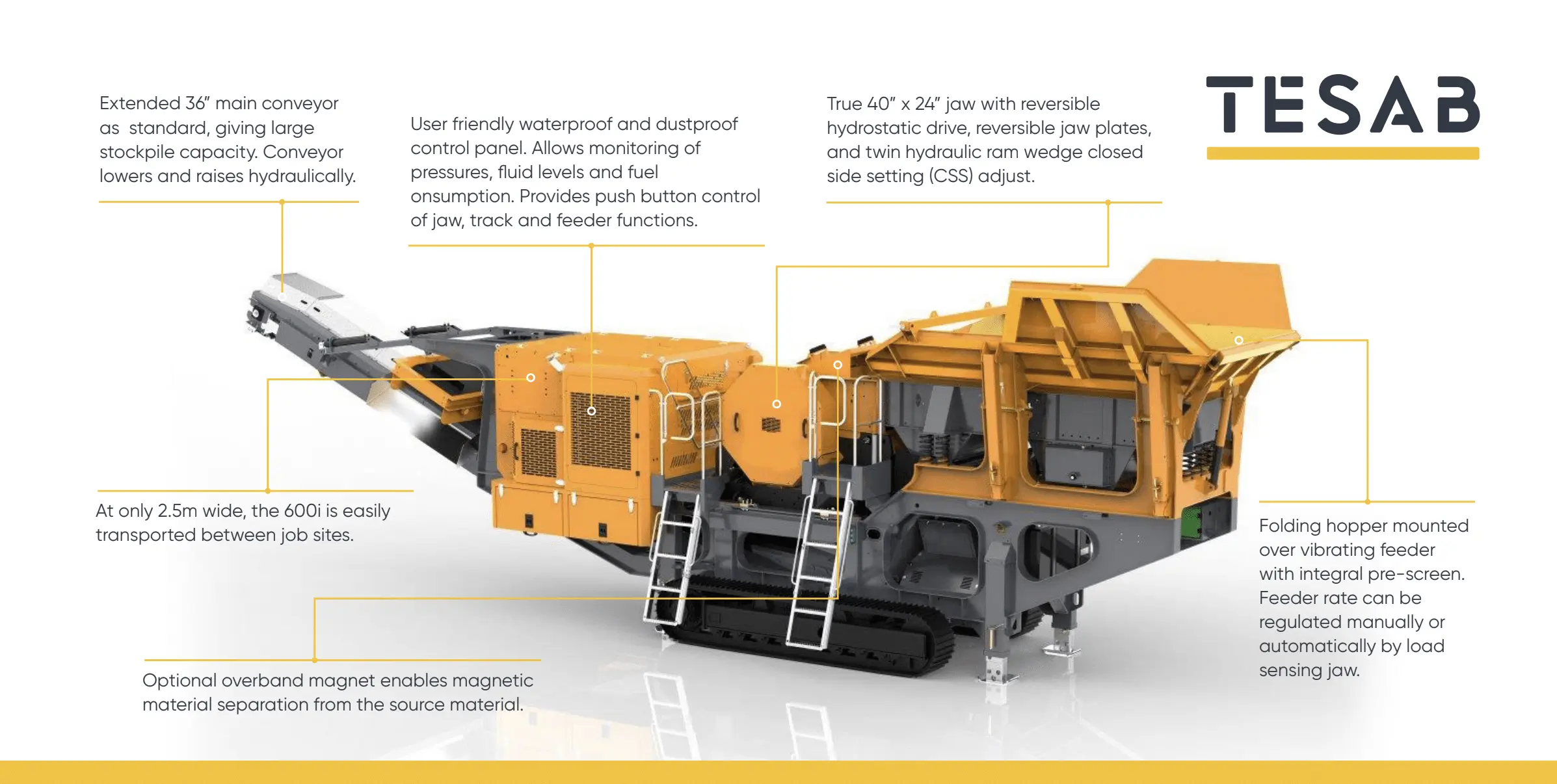
A jaw crusher is typically used during the primary crushing stage of a material-processing operation. Large rocks or other materials are fed into the crushing chamber, where they are compressed between a fixed jaw and a moving jaw.
As the material passes through the crusher, it is reduced in size before being discharged onto the conveyor.
Jaw crushers are particularly well suited to hard and abrasive materials, making them a popular choice for quarrying and aggregate production. They can also be used for applications including construction and demolition recycling.
A mobile tracked jaw crusher adds another major benefit: mobility. Instead of being permanently installed in one location, the crusher can be moved around a site or transported between projects, depending on the machine configuration and transport requirements.
The Tesab Jaw Crusher Range
Tesab’s current jaw crusher range includes several models designed to cover different production requirements.
These include:
The machines increase in size and production capability through the range, while the hybrid-electric 700ie and 800ie provide alternative power and operating options.
The choice between them will depend on factors such as feed size, required production rate, site conditions, material characteristics and whether hybrid-electric operation could benefit your application.
Tesab 500i Jaw Crusher
The Tesab 500i is the smaller machine within the current Tesab jaw crusher range and provides an option for operations where a more compact primary crusher is required.
According to Tesab’s published specifications, the 500i has a maximum feed size of 400mm and a production capacity of up to approximately 150 tonnes per hour, depending on application. Banner Equipment’s Tesab brochure lists a 2.75m³ hopper and an 890mm x 500mm feed opening.

What is the Tesab 500i best used for?
The 500i can be a useful option for businesses that need primary crushing capability without moving into the larger production capacities of the 700i and 800i.
Potential applications include:
- Smaller quarrying operations
- Construction projects
- Recycling applications
- Processing aggregates
- Contractors working across multiple sites
- Primary reduction of suitable rock and other materials
Its smaller footprint can also make a compact jaw crusher attractive where site access and manoeuvrability are important considerations.
For contractors who don’t require the production capacity of a larger machine, a crusher such as the 500i can provide a practical way of adding primary crushing capability to their equipment fleet.
Tesab 600i Jaw Crusher
Stepping up from the 500i is the Tesab 600i.
The 600i provides greater capacity and a larger feed opening, making it suitable for operators processing more material or larger feedstock.
Banner Equipment’s published Tesab specifications list the 600i with a maximum feed size of 500mm, production of up to approximately 225 tonnes per hour, a 1,016mm x 610mm feed opening and an estimated machine weight of 34,600kg, although specifications can vary depending on options and application.
What is the Tesab 600i best used for?
The 600i is worth considering for applications where the 500i’s capacity may not be sufficient, but a larger 700i or 800i isn’t necessarily required.
Typical applications can include:
- Aggregate production
- Quarrying
- Construction and demolition recycling
- Primary crushing
- Road construction
- Processing blasted or excavated rock
The 600i can therefore sit between compact and higher-capacity crushing requirements, offering operators additional production capability while retaining the advantages of a mobile jaw crusher.

Tesab 700i Jaw Crusher
The Tesab 700i is one of the standout machines in the Tesab jaw crusher range and is specifically designed with contractors in mind.
Based on the proven Tesab 10570, the 700i was developed as a more streamlined tracked jaw crusher while retaining the robust crushing unit associated with its predecessor. Tesab states that the machine can produce 350+ tonnes per hour, depending on application.
The 700i has a maximum feed size of 700mm and features a two-deck independent pre-screen as standard.
The pre-screen can help separate fines before material enters the crushing chamber. This can improve material separation and potentially reduce the amount of material requiring crushing.
The machine also features Tesab’s step-deck vibrating feeders, designed to handle dry, damp or wet material.
What is the Tesab 700i best used for?
The 700i is particularly well suited to contractors and aggregate producers looking for a versatile, high-production primary crusher.
Potential applications include:
- Quarrying
- Hard-rock crushing
- Aggregate production
- Construction and demolition recycling
- Road construction
- Large-scale site development
- Primary crushing ahead of impact crushers and screeners
Its tracked configuration also makes the 700i suitable for businesses that need to move the machine between working areas or projects.
Banner Equipment describes the 700i as a primary crushing machine that can operate as a standalone unit fed by an excavator or integrate with Tesab secondary crushers and screeners.
Tesab 800i Jaw Crusher
Moving further up the range is the Tesab 800i, designed specifically for demanding quarry applications and primary rock crushing.
The 800i is based on the proven Tesab 10580 and has been developed to provide high-volume primary crushing. Tesab currently lists production of 400+ tonnes per hour, with an 800mm maximum feed size.
One of the important features of the 800i is its two-deck independent pre-screen, which comes as standard.
This allows material to be separated before it enters the jaw crusher. In applications containing a significant amount of fines, this can help improve the efficiency of the crushing process and reduce unnecessary wear.
The 800i’s step-deck vibrating feeder is also designed to handle dry, damp and wet material.
What is the Tesab 800i best used for?
The 800i is designed for high-output applications where production requirements are substantial.
It can be particularly suitable for:
- Large-scale quarrying
- Hard-rock crushing
- Primary aggregate production
- High-volume construction projects
- Large infrastructure projects
- Primary crushing ahead of secondary and tertiary equipment
Tesab specifically describes the 800i as being designed for the quarry market and primary rock crushing at the quarry face.
For operators processing large quantities of hard material, the 800i provides a higher-capacity alternative to the 700i.
Tesab 700ie Hybrid Electric Jaw Crusher
The Tesab 700ie is based on the 700i but introduces a hybrid-electric drive system.
Tesab states that the 700ie can produce 350+ tonnes per hour, matching the production capability of its diesel equivalent while offering a different approach to powering the machine.
The crusher uses electric drives while crushing and can operate from its removable diesel generator set or, where suitable infrastructure is available, mains electricity.
Tesab states that the 700ie can use less than 20 litres of fuel per hour and offers the potential for lower operating costs when mains electricity is available.
What is the Tesab 700ie best used for?
The 700ie could be particularly interesting for operators looking to combine high production with alternative power options.
Potential applications include:
- Quarrying
- Hard-rock crushing
- Aggregate production
- Recycling
- Construction projects
- Sites with access to mains electricity
- Operations looking to reduce diesel consumption
The machine also features automatic crusher unblock and reverse operation, alongside an integrated control panel with a display interface and remote-access capabilities.
For businesses considering the transition towards more electrically driven equipment, the 700ie provides an alternative to a conventional diesel-powered tracked jaw crusher.
Tesab 800ie Hybrid Mobile Jaw Crusher
At the top end of the current hybrid-electric range is the Tesab 800ie.
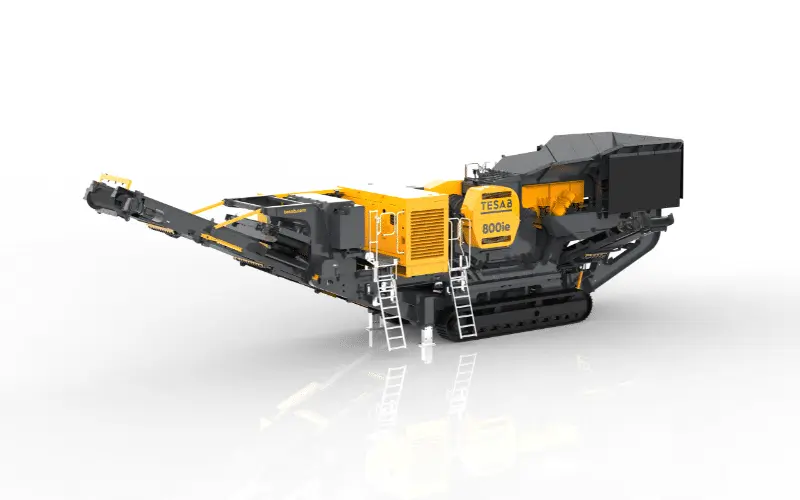
Tesab describes the 800ie as its largest hybrid crusher and says it is designed for primary hard-rock crushing. It has a stated capacity of 450+ tonnes per hour and uses electric drives while crushing.
Like the 700ie, the 800ie can be powered by its removable onboard diesel genset or connected to mains electricity where appropriate.
Tesab also states that the machine can deliver up to 33% greater fuel efficiency and up to 70% reduced operating costs compared with the relevant conventional configuration, depending on operating conditions. These figures are manufacturer claims and actual results will vary according to application and site conditions.
What is the Tesab 800ie best used for?
The 800ie is aimed at demanding primary crushing applications where high production is required alongside the potential benefits of electric drive.
It could be considered for:
- Large quarrying operations
- Hard-rock crushing
- High-volume aggregate production
- Major infrastructure projects
- Sites with mains electricity
- Operations seeking to reduce diesel usage
The 800ie can also feed directly from an excavator and integrate with secondary crushing and screening equipment.